
590 nm Narrow Spectrum Lighting
Lighting for Photosensitive Manufacturing Applications
It is well-known that UV light is damaging...but even normal white light contains some damaging shorter wavelengths. Therefore, life sciences and manufacturing use Amber LED Lighting to avoid negative outcomes resulting from overexposure to the shorter wavelength found in ordinary light.
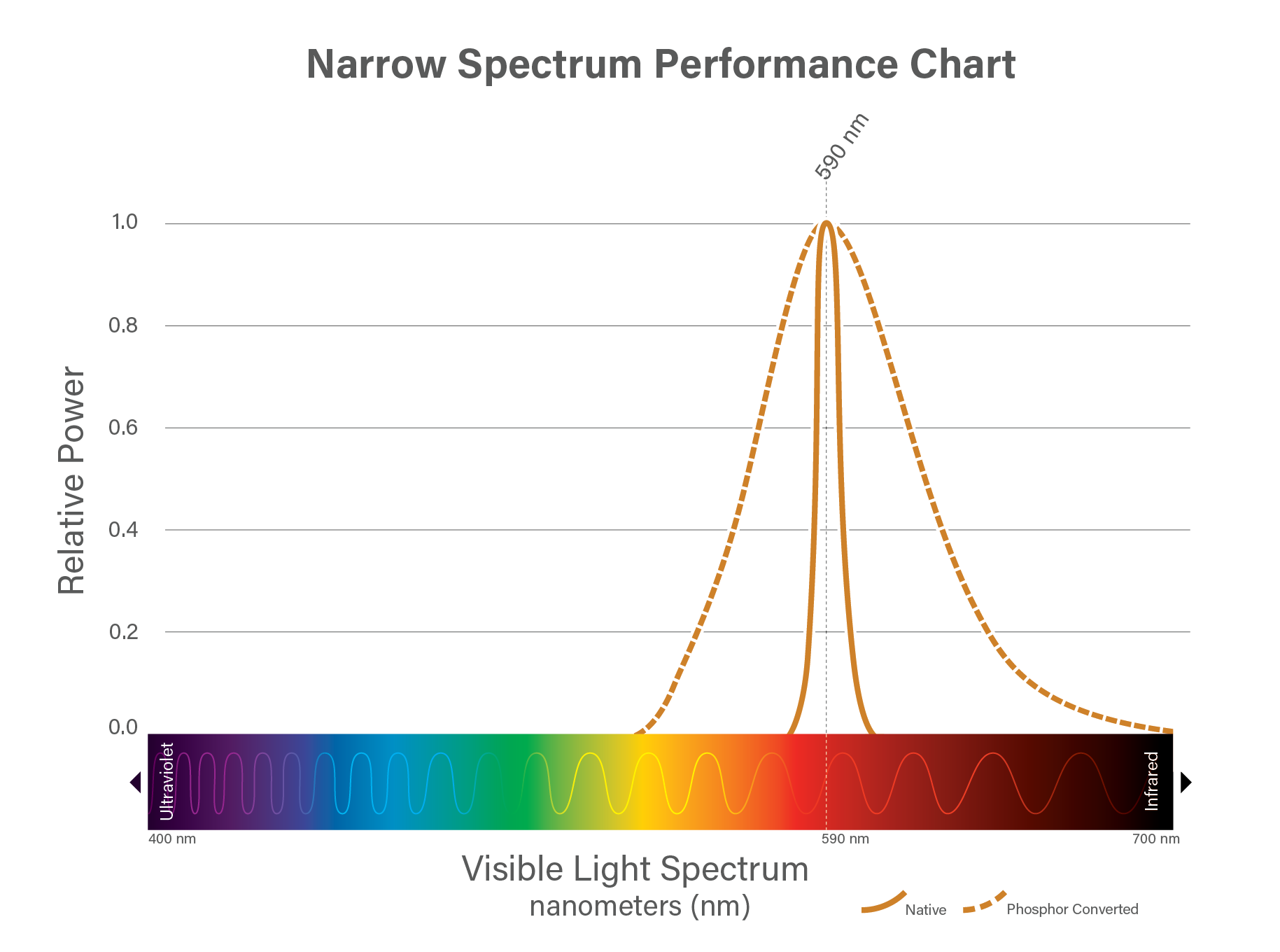
Native vs Phosphor Converted
Native narrow spectrum and phosphor-converted narrow spectrum LEDs both produce light at a specific wavelength. How they go about it, however, differs.
Native Narrow-spectrum Lighting
Native narrow-spectrum lighting uses LEDs engineered to emit light within a very tight bandwidth—typically less than 20 nm around a specific peak wavelength—through semiconductor alloys that generate the target color directly*. Because these LEDs do not rely on phosphors to convert light from one color to another, they deliver exceptionally high color purity. When an application requires a single, well defined wavelength, native narrow spectrum LEDs can offer higher efficiency and simpler system design by avoiding unwanted wavelengths.
Conversely, native narrow spectrum lighting may not have the same color versatility, light output, or life as phosphor-converted options, particularly when producing broader spectra, such as white light.
Phosphor-converted Narrow-spectrum Lighting
Phosphor-converted (PC) narrow-spectrum lighting uses blue or near-UV LEDs, which are then converted by phosphors to emit light at a narrower, desired spectrum. Phosphor-converted amber light is created using a blue semiconductor material called Indium gallium nitride (InGaN), together with a phosphor, to convert native blue light into longer wavelength amber light. PC amber provides high performance, long life, and high efficiency—which is desirable for high illumination applications.
Wildlife Sensitive 590 nm Lighting
Ideally, lighting should always enhance the beauty and well-being of the natural world. At Kenall, we support Legrand’s larger mission to protect our planet by offering luminaires that complement our surroundings without disrupting them.