

The path to improving whole‑room disinfection just got a whole lot brighter
CONTIUOUS, AUTOMATIC, GAME-CHANGING: VISIBLE LIGHT DISINFECTION
What if the lighting used throughout your facility came with the added benefit of fighting bacteria and viruses? Now it can, with Indigo‑Clean technology. Indigo‑Clean continuously and automatically kills bacteria and viruses. Multiple studies show 405 nm technology kills Staph (including MRSA1), and C. Diff2, SARS‑CoV‑2, Influenza‑A3, and a list of other pathogens.
Indigo‑Clean works while people are in the room
Unlike other lighting disinfection technologies, Indigo‑Clean uses the visible light spectrum. As such, it is classified as 'risk exempt' by the International Electrotechnical Commission (IEC 62471). Additionally, many published, peer‑reviewed studies have shown that its level of irradiance causes NO damage to human skin or eyes4,5—even when performing at the highest level of disinfection. This means rooms can remain occupied when the light is on.
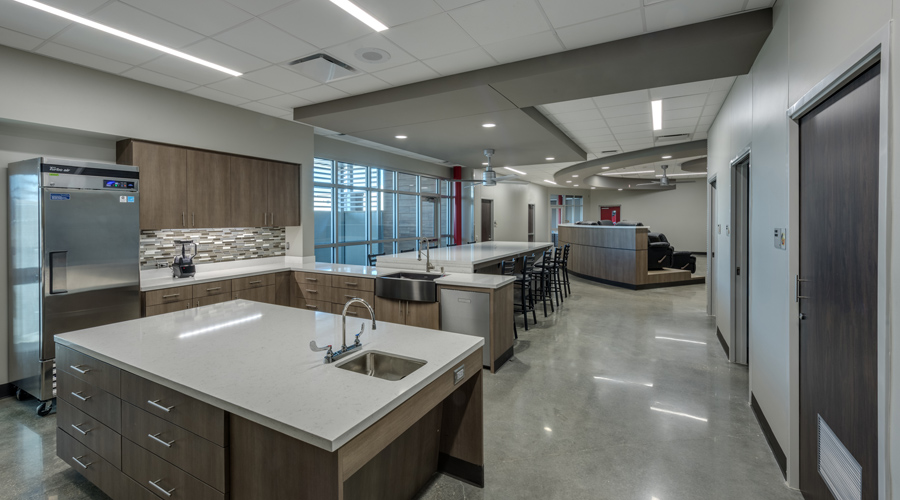
Shown to kill pathogens, cut costs, and add value.
For almost a decade, this patented lighting technology has been effectively used by hundreds of facilities to reduce bacteria, such as Staph, including MRSA. It has been shown to be highly effective in killing viruses; expanding its use to include offices, schools, hospitality, retail, and other congregate settings.
Indigo‑Clean technology can help reduce the costs associated with C. diff and MRSA, as well as SARS‑CoV‑2 and Influenza‑A transmission.
Destroy bacteria.
Indigo‑Clean technology functions effectively even while people are present, providing continuous and automatic germ fighting performance via your overhead lighting.
Realizing a significant return on investment
No matter where you go, Indigo‑Clean is trusted to keep spaces clean by continuously reducing pathogen levels. Use it to maintain the bioburden reduction between terminal cleanings.
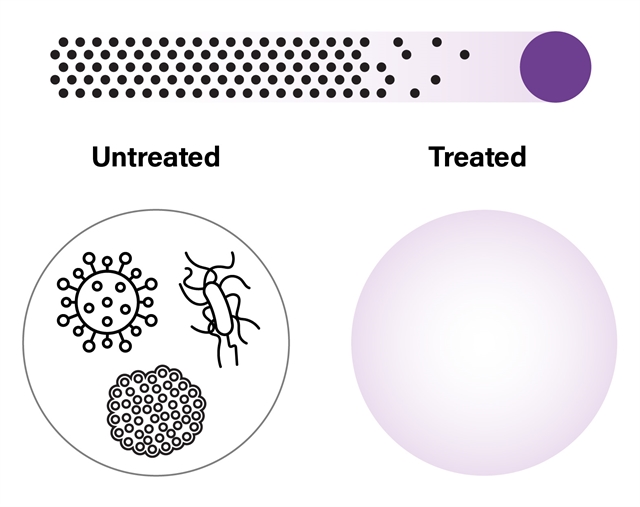
Eliminating a range of pathogens
| Virus3 | ESKAPE Pathogens6 | Microorganisms |
|---|---|---|
|
|
|
Killing pathogens in the air, and on surfaces.
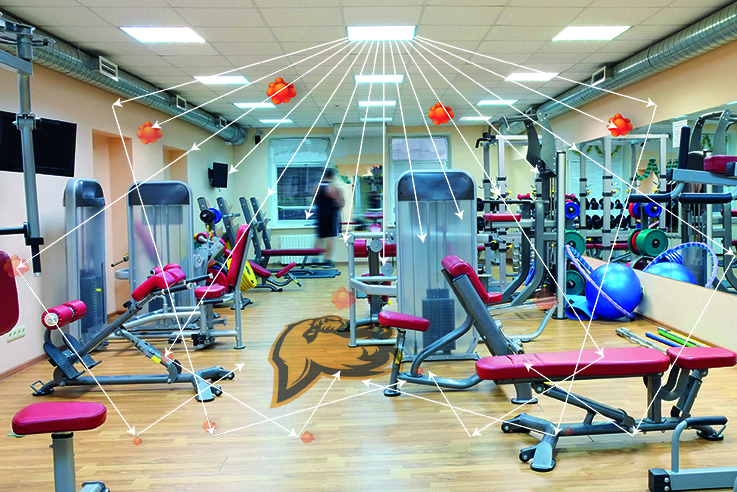
Using a patented blend of 405 nanometer indigo and white LED light, Indigo-Clean technology bathes spaces in germ‑fighting protection. Due to the reflective nature of light, Indigo‑Clean reflects off walls and other surfaces to reach the many shadowed areas other disinfection technologies often miss. Once exposed, pathogens are oxidized from within, no matter where they exist: in the air and on surfaces.
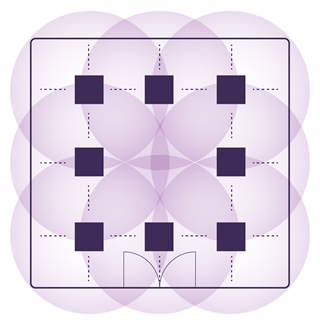
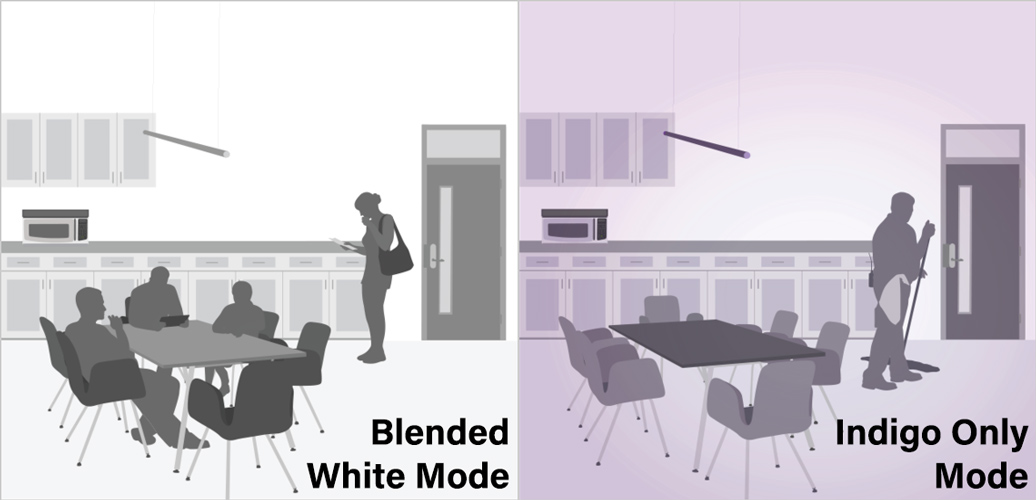
Around‑the‑clock environmental disinfection.
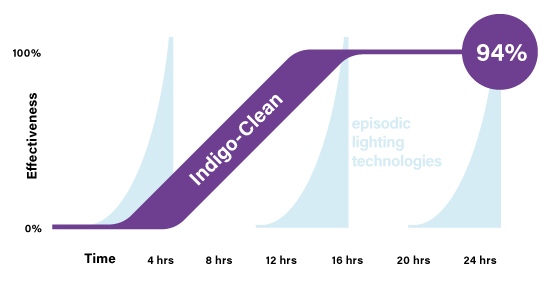
Rather than relying solely on staff to clean surfaces, or HVAC systems to purify the air, Indigo‑Clean combines the benefits of both. Although unnoticeable, our technology is always working to reduce viruses and bacteria; maintaining disinfection between routine cleanings and filling the gap left by episodic (or non‑continuous) disinfection methods.
Designed to address entire facilities, Indigo‑Clean technology is an effective and fundamental part of any disinfection strategy.
FAQs
Indigo-Clean, an environmental microbial reduction technology, uses visible light to kill harmful viruses and bacteria continuously and automatically in the environment, while also providing ambient illumination within the space. Indigo-Clean is a technology integrated into light fixtures that install easily into the ceiling to bolster your current cleaning protocols and maintain the bioburden reduction between terminal cleanings. Indigo Clean Technology uses a 405 nm wavelength of light (part of the visible light spectrum) to reduce microbial load, which means the room can be occupied while the light is on.
Indigo-Clean technology was invented by the University of Strathclyde, Scotland in 2005. Commercialization efforts have also included a range of laboratory tests, primarily focused on the application science, and demonstrating the performance of the technology in occupied spaces.
Indigo-Clean is certified ‘Risk Exempt’ by the International Electrotechnical Commission (IEC), an internationally recognized standard for the photobiologic safety of lamps and lamp systems: IEC 62471. This means that people can occupy the space for any period of time without the need for exposure limits. Published scientific studies show no damage to human skin and eyes from exposure to 405 nm light at the level of irradiance in which Indigo-Clean operates.
With the need for automatic microbial reduction, Indigo-Clean is ideal for use in a wide variety of public settings where people congregate.
Indigo-Clean uses a visible wavelength of light: 405 nm generated from state-of-the-art advances in LED technology. This technology, which has been studied extensively, is shown to kill harmful viruses, bacteria and fungus. The 405nm wavelength emitted from Indigo-Clean targets and excites naturally occurring molecules within the pathogens called porphyrins, to produce intra-cellular Reactive Oxygen Species (ROS). Similar to bleach, these ROS create an oxidative environment within the organism, inactivating it and preventing it from repopulating the space. This visible wavelength of light reflects off walls and surfaces, providing microbial reduction even in shadowed areas.
Depending on the product, the color of light produced by an Indigo-Clean fixture may appear slightly different than a normal light fixture due to the addition of 405 nm light. However, in isolation, this difference is not discernable to the human eye.
The dose index factor scientifically determines the necessary light coverage for the space based on the specific product being installed.
Environmental microbial reduction is the destruction of microorganisms in the air and on surfaces. Its ultimate purpose is to reduce the level of pathogens in spaces where they often reside and re-populate.
Current environmental microbial reduction methods are applied at discrete moments in time, classifying them as “episodic.” To date, Indigo-Clean is the only visible light microbial reduction technology with a proprietary dosing algorithm for microbial reduction. The bacterial reduction target employed in the algorithm is supported by both published, peer reviewed studies and extensive laboratory testing.
No. Indigo-Clean technology is designed to reduce harmful pathogen levels in the environment by supplementing your current disinfection efforts. It helps maintain the bioburden reduction between terminal cleanings.
Visible light’s (405 nm) mechanism of action is achieved via a slow generation of oxidative stress inside pathogenic cells. As a result, the disinfection is measured over a 24-hour cycle. In instances where pathogens are constantly being reintroduced into the room, Indigo-Clean technology is in continuous operation, providing a reduction of the bioburden within the space.
Kenall’s Indigo-Clean is manufactured in the heartland of the U.S., in a vertically integrated manufacturing facility in Kenosha, WI.
Kenall’s EPA establishment number for Indigo-Clean is 99283-WI-1, as assigned in since 2020. As such, Kenall considers Indigo-Clean to be a pesticidal device. It is not intended to be a medical device and has not been approved or cleared by the U.S. Food and Drug Administration for use as a medical device.
- 1 Rutala W. et al. Antimicrobial Activity of a Continuous Visible Light Disinfection System, Infect Control Hosp Epidemiol. (2018) 39(10):1250-1253. doi: 10.1017/ice.2018.200.
- 2 independent lab report #SGS-09S17036476 Contact Kenall Lighting for a copy of this report
- 3 Rathnasinghe R. et al. The virucidal effects of 405 nm visible light on SARS-CoV-2 and influenza A virus. Sci Rep. (2021) 11:19470. doi: 10.1038/s41598-021-97797-0.
- 4 Niwano Y. et al. Blue light injures corneal epithelial cells in the mitotic phase in vitro. Br J Ophthalmol. (2014) 98(7):990-2. doi: 10.1136/bjophthalmol-2014-305205.
- 5 Hacham H. et al. Does exposure of human skin in situ to 385 or 405 nm UV induce pyrimidine dimers in DNA? Photochem Photobiol. (1990) 52(4):893-6. doi: 10.1111/j.1751-1097.1990.tb08698.x.
- 6 Sinclair L.G. et al. Enhanced antimicrobial efficacy and energy efficiency of low irradiance 405-nm light for bacterial decontamination. Arch Microbiol. (2024) 206(6):276. doi:10.1007/s00203-024-03999-1.
- 7 Murdoch L.E. et al. Lethal effects of high intensity violet 405‐nm light on Saccharomyces cerevisiae, Candida albicans and on dormant and germinating spores of Aspergillus niger. Fungal Biology (2013) 117; 519‐527. doi: 10.1016/j.funbio.2013.05.004.
- 8 Murduch L.E. et al. Bactericidal Effects of 405 nm Light Exposure Demonstrated by Inactivation of Escherichia, Salmonella, Shigella, Listeria, and Mycobacterium Species in Liquid Suspensions and on Exposed Surfaces. Scientific World Journal. (2012) 2012:137805. doi: 10.1100/2012/137805.